

TruAge Epigenetic Test
Measures your biological age, pace of aging, and the biological age of 11 major body systems.
780EUR
Buy
Your chronological age is only one number.
Epigenetic testing provides a deeper understanding of how your body is ageing by analysing biological processes reflected in your DNA.
The results help assess biological age, pace of ageing, organ health, and other key longevity markers—offering meaningful insights that can guide more informed health decisions.

In partnership with a laboratory whose methodologies are developed alongside researchers from Harvard, Yale, Cornell, Duke, and other leading universities, we provide advanced epigenetic testing.
The testing is supported by more than 30 clinical studies and provides insights into biological age, pace of ageing, organ health, and other important longevity markers.



Epigenetics explores how lifestyle and environmental factors influence gene activity without changing your DNA.
This means that everyday choices – such as sleep, nutrition, physical activity, and stress – can affect how your body functions.
Epigenetic testing measures these changes at the cellular level, helping you make more informed decisions about your long-term health.
Epigenetic testing reflects your body’s current biological state – not just your genetic potential – and shows how lifestyle may be influencing your health today.
The analysis evaluates more than 850,000 DNA methylation sites, providing a detailed picture of your body’s biological condition.
Sleep, nutrition, physical activity, stress, and environmental factors all leave measurable biological signatures. Epigenetic testing helps reveal how these factors may be influencing your body.
Every person is unique. Your results provide personalised insights into your strengths, potential risk factors, and areas that may deserve greater attention.
Our testing methodology is built on the latest advances in epigenetic science and supported by more than 30 clinical studies, helping you make more informed decisions about your long-term health and longevity.
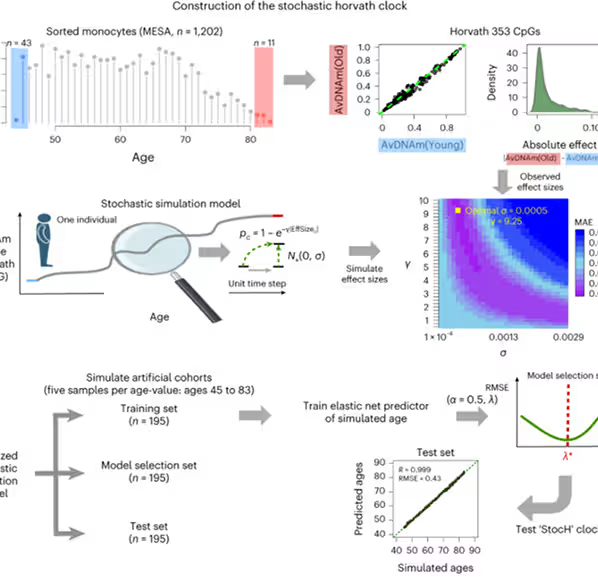
Simulating DNAm drift in >22k blood samples shows stochastic change explains 66–75 % of Horvath clock accuracy, 90 % for Zhang, but 63 % for PhenoAge, implying true aging reflects non-stochastic biology. Male, severe COVID-19 and smoker accelerations stem from these non-random effects.

In an 8-week twin study, only the vegan diet cut epigenetic age: lower PC GrimAge, PC PhenoAge, DunedinPACE and reduced aging in inflammation, heart, hormone, liver and metabolic systems. Omnivores didn’t shift, underscoring plant-based diets’ anti-aging edge.
Simulating DNAm drift in >22k blood samples shows stochastic change explains 66–75 % of Horvath clock accuracy, 90 % for Zhang, but 63 % for PhenoAge, implying true aging reflects non-stochastic biology. Male, severe COVID-19 and smoker accelerations stem from these non-random effects.